I wasn’t trying to take photos.
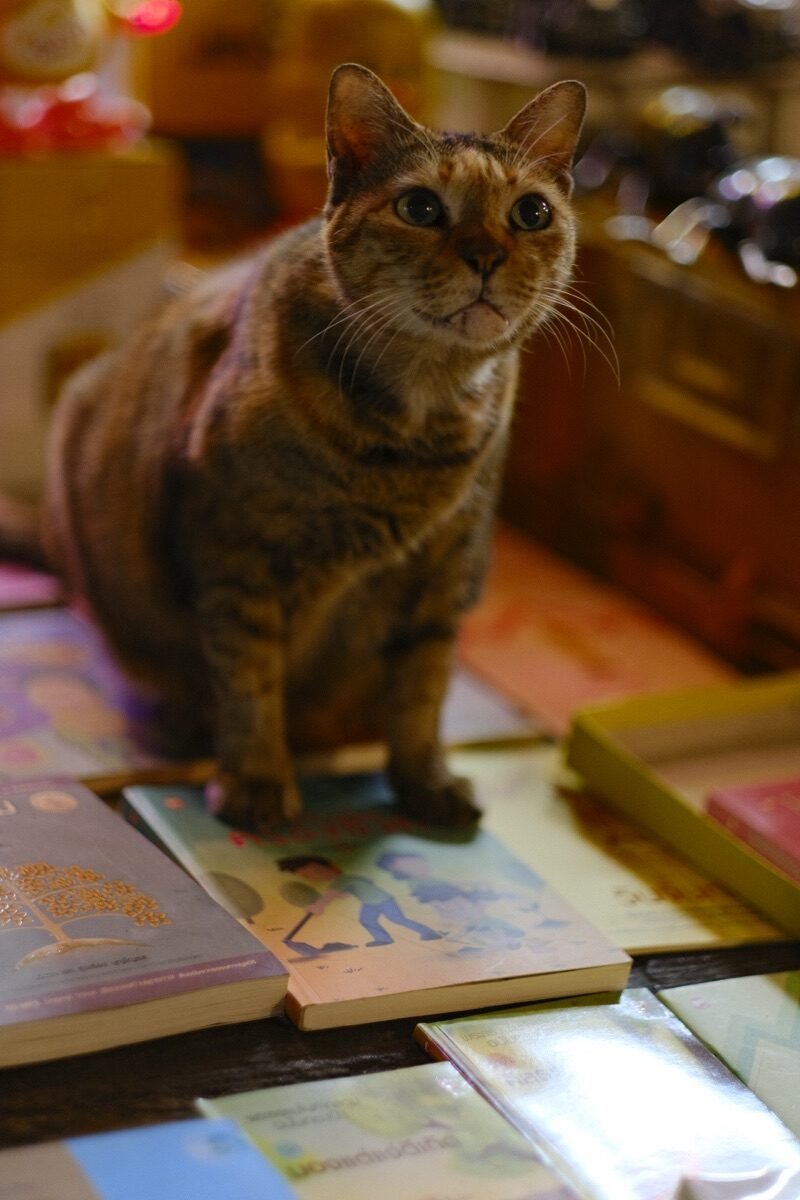
I was walking through Chinatown at night with no particular direction, camera over my shoulder, not thinking about light or composition or anything useful. Then a cat sitting on a pile of books in a small bookshop looked up at me. I raised the camera and clicked once.
That’s the whole story. Which is the point.
Photography writing spends a lot of time on intention. Go out with a plan. Work a scene. Return to the same street at the same hour until you understand it. There’s value in that. It’s also not how this shot happened, and it’s not how most of my Bangkok shots happen.
Bangkok doesn’t reward the hunter. It rewards the person who showed up for something else.
The city moves at a pace that makes deliberate street photography feel slow and slightly false. By the time you’ve identified a scene, framed it, and committed, it’s already different. What works better, what I’ve found works better, is carrying the camera and not performing photography. Walking to get somewhere. Stopping because you’re hot. Turning into a soi because it looked shorter. The shots that come from that are different from the ones you go looking for.
The cat was in a small bookshop somewhere off Yaowarat. The books were Thai. The light was whatever the shop had, tungsten and not much of it. I didn’t think about any of that.
I shoot SOOC on Provia. The decision to commit to a film simulation at capture, and not touch it after, started as a constraint and became something else.
When you know you can fix the colour in post, you make different decisions with your feet. You accept more marginal light because you’ll sort it later. You don’t move because the framing is close enough. The fix-it-later option keeps you slightly lazy in ways you don’t notice until you remove it.
I was at 35mm, wide open at f1.2. Not a decision. That bookshop had tungsten light and not much of it. f1.2 was what the scene required. The background dissolved because physics, not because I planned a clean separation between the cat and the books behind it.
I didn’t calculate whether Provia would handle the tungsten warmly enough. I just trusted it and shot. The frame I got is the frame. There’s no version where I pulled the warmth down or lifted the shadows. That’s either a complete picture or it isn’t.
In this case it was. The warmth earned its place. The cat’s fur and the book covers and the background blur landed close enough to what I saw that I didn’t wish for another version.
I don’t always get that. Sometimes I trust it and the scene needed something the simulation doesn’t do. That’s the cost of the constraint. I’ve decided it’s worth it because the alternative, infinite post-processing flexibility, was making me a worse photographer at the moment of capture. The constraint pushed the decision back to where it belongs.
What I haven’t resolved: I still don’t know how much of what I’m calling “seeing” is skill and how much is just time in the city. Bangkok is familiar now in a way it wasn’t two years ago. I know which neighbourhoods move slowly enough to give me a moment. I know roughly what Provia does with heat and neon. I know to keep the camera out.
Whether that’s vision or just pattern recognition, I’m not sure the difference matters. The cat looked up. I had the camera. The frame worked.
That’s enough for now.
